


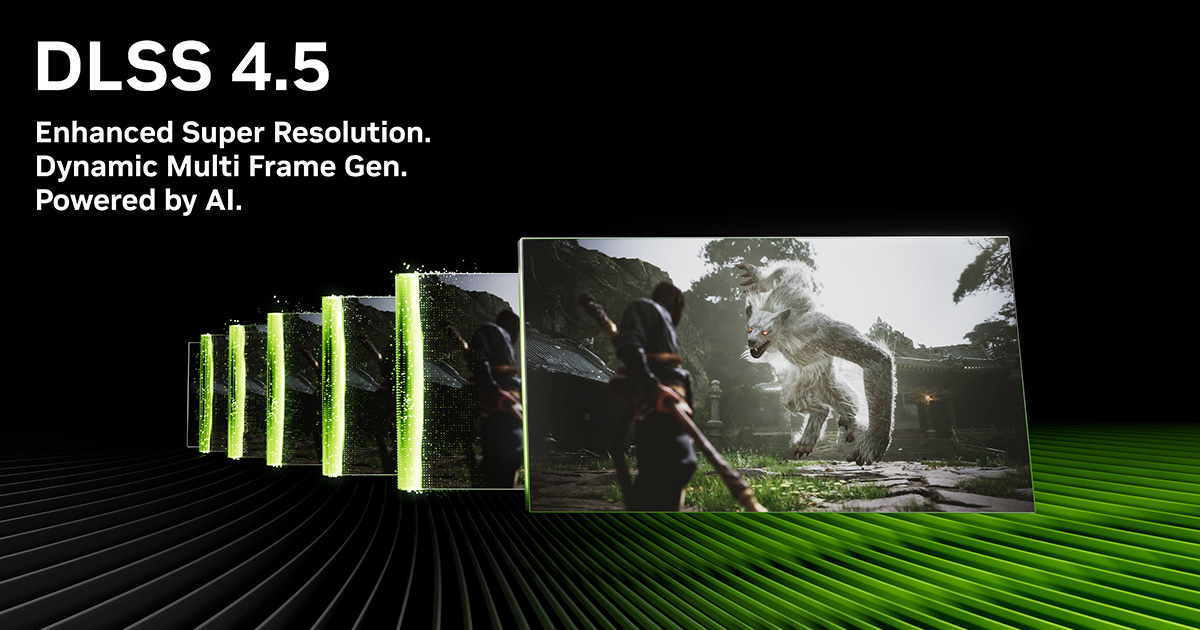

🆕 Nvidia has released a new version of its DLSS upscaler as part of a thin silver lining for gamers at CES 2026
🙌 The new DLSS 4.5 upscaler refines the Transformer model introduced as part of DLSS 4 with better detail retention, reduced ghosting and smoother edges
👍 It also adds a new 6x multiplier for Multi-Frame-Gen tech, and a new Dynamic mode
🚨 The update is available now, although to get the most out of it, you will need an RTX 50-series graphics card
Nvidia’s CES 2026 keynote was notable for being the first one in five years where Team Green didn’t announce any new consumer GPUs, although the news of DLSS 4.5 provides a saving grace for gamers.
The keynote was mostly focused on Nvidia’s upcoming advancements in the AI sector instead, where most of the money is for the firm, it seems. However, the shadow dropping of an update to Nvidia’s upscaler today is a large leap forward.
In a nutshell, DLSS stands for Deep Learning Super Sampling, and uses AI to increase image quality and performance of what you’re playing. In basic terms, it works by rendering a displayed image at a lower resolution and uses a custom neutral network with super sampling to upscale the image to the resolution you’re targeting, bringing higher frame rates than natively rendering a title at the desired resolution using your GPU’s raw grunt.
It’s useful in a general sense for bringing more responsive gameplay, although arguably it has most of its benefits when rendering something tricky, such as real-time ray-tracing.
For some folks, the DLSS upscaler in play is unnoticeable, although it hasn’t stopped Nvidia from making gradual refinements in the last few years to make it as indiscernible and as smooth as possible.
DLSS 4.5 builds on the upgrades that last year’s DLSS 4 provided, such as Multi-Frame-Gen and a new Transformer model that provided a sharper and cleaner image than the older CNN model.
It provides a new version of the Transformer model called Super Resolution Transformer, which Nvidia says yields even stronger image quality than before, with better detail, reduced ghosting and smoother edges. It’s less likely to have issues with fast-moving action or smaller details in the distance.
This new Super Resolution Transformer model is fully compatible with RTX 40 and 50-series GPUs, although you can still get some benefit on older RTX 30 and even 20-series cards, according to Nvidia, providing some incentive to keep older cards going.
Arguably, the more controversial upgrade is that to Multi-Frame-Gen. If you weren’t aware, MFG is exactly as it sounds, with new frames generated in a game from scratch by both upscaling frames created by the game for smoother performance and using AI to create new ones.
The AI looks at two frames generated by the game, and then inserts another one between them to, theoretically, yield a higher frame rate and a smoother-feeling image.
With DLSS 4, you had the option to either 2x, 3x, or even 4x your FPS figure in supported titles, although in any case, it’s reliant on having a base FPS figure (depending on the raw power of your system and settings chosen) high enough so that there isn’t noticeable latency when bumping up to the MFG number.
DLSS 4.5 adds two key benefits for MFG, with a new 6x multiplier that could theoretically take a 60fps game and turn it into a 360fps one, making full utilization of a high refresh rate 360Hz gaming screen, such as the new Acer Predator XB273U F5 with its G-Sync Pulsar powers.
Up next: Sony’s Honda Afeela car has PS Remote Play support and emotor sounds from Astro Bot, Gran Turismo
Reece Bithrey is a journalist with bylines for Trusted Reviews, Digital Foundry, PC Gamer, TechRadar and more. He also has his own blog, UNTITLED, and graduated from the University of Leeds with a degree in International History and Politics in 2023.