





👻 Snap just unveiled Specs, its first AR glasses for consumers, at AWE 2026
👓 They blend the everyday wearability of normal glasses with the see-through, spatial-computing power you’d expect from a headset
🐉 Two Qualcomm Snapdragon chips run the show, with up to 4 hours of mixed-use battery and no tethered battery
📺 The 51º field of view and 16M-color display feels like a 24-inch monitor for work – or a 115-inch movie screen for streaming
🤖 Voice control, hand tracking, and AI that can actually see what you’re looking at
💰 $2,195, shipping this fall in the US, UK, and France. Pre-orders open today with a $200 refundable deposit
Picture a 100-inch movie theater that only you can see, floating on the wall of your apartment. Walking directions painted onto the sidewalk in front of you so you never get lost. AI that answers questions about whatever you’re actually looking at – no phone, no looking down.
That’s the everyday pitch behind Snap’s new Specs, and after years of “smart glasses” that mostly just snapped photos and relayed your texts, this is the first pair that feels like the future strapped to your face.
Snap – yes, the company behind Snapchat – made it official today at Augmented World Expo: Specs are its first pair of augmented reality glasses built for actual people instead of developers in a lab. (And no, that’s not a typo for “spec sheet.” Specs is the name.)
Full disclosure: I’ve been on this ride since the very start. I reviewed the original Snapchat Spectacles at TechRadar back in 2016 – the yellow camera-sunglasses that shot circular video for Snapchat and, true story, nearly got me thrown out of Yankee Stadium. My verdict at the time boiled down to “fun, but it’s a toy for Snapchatters.” 10 years later, Snap has come a very long way – this is no longer a toy.
Where Specs out-see the Apple Vision Pro
Specs are a fully standalone wearable computer crammed into a pair of glasses. No puck. No tether. No phone required. You put them on, look straight through the lenses like normal eyewear, then flip on Snap OS and watch your field of view fill up with apps, AI, and 3D experiences floating in the space around you.
Maybe this is what an “Apple Vision Air” was supposed to be.
Here’s the part that matters: these aren’t a heads-up display bolted onto sunglasses. They’re real see-through AR – digital content anchored in the actual room in front of you. Think Apple Vision Pro magic, minus the ski-goggle silhouette and the battery brick on your hip. Maybe this is what an “Apple Vision Air” was supposed to be.
The Vision Pro fakes “seeing the real world” by piping camera feeds to screens inside the headset. Specs skip all that – you’re literally looking through clear glass. That difference is bigger than it sounds, and it’s the reason these can pass as everyday glasses instead of a gadget you strap on for a demo.
The killer feature might be never getting lost again
Max and I have been banging this drum for years, both on The Shortcut and back when I was at TechRadar: the single most useful thing true AR glasses can do is guide you through physical space. Not a tiny map in the corner of your eye – an actual line on the ground leading you exactly where you need to go.
Imagine a glowing path leading you down a stadium aisle to your exact seat location.
Snap demoed precisely that: directions appearing right on the street in front of you. But here’s the version I can’t stop thinking about: imagine a glowing path leading you down a stadium aisle to your exact seat location – at the same kind of sports stadium that once tried to eject me for wearing Spectacles. Or a line snaking through the grocery store straight to that one item buried on shelf four of aisle 11. Or my favorite techie example: navigating CES, where an Uber drops you off at the front of a hotel in Las Vegas, and the meeting room you need to go to is located through a casino that feels like a labyrinth.
That’s the moment AR glasses stop being a novelty and start being something you’d genuinely miss when you take them off.
The biggest screen nobody else can see
The headline feature lives in the lenses. Snap uses its own liquid-crystal-on-silicon display tech to beam a 51º field of view with 16 million colors right into your sightline.
Specs have a movie-theater-sized screen only you can see.
That 51º number is worth pausing on: it’s genuinely wide for true see-through AR. The waveguide “notification” glasses that just float a little box of text in front of you – think Meta’s Ray-Ban Display – work in a much narrower window.
Specs give you enough room that, per Snap, it feels like a 24-inch monitor when you’re working or a 115-inch home theater when you’re watching a movie. (Tethered “display glasses” like Xreal and Viture quote similar numbers, but those are essentially a floating screen you plug into a phone – Specs pull it off standalone.) Either way: it’s a movie-theater-sized screen only you can see.
Tinted like a Boeing 787 Dreamliner
The lenses pull another neat trick. They use electrochromic tinting – the same idea behind the dimmable windows on a Boeing 787 Dreamliner – shifting from clear to tinted in about 10 seconds so the display stays readable whether you’re inside or out in the sun.
Here’s why that’s a bigger deal than it sounds, and a personal gripe of mine: the photochromic “transitions” lenses in a lot of sunglasses – yes, including my Meta Ray-Bans – react to UV light, which makes them slow to darken and unreliable when you’re constantly ducking between sun and shade. Not ideal for a bright walk through NYC. Electrochromic lenses are electrically controlled instead, like a 787 window you dim on command rather than one waiting on the weather.
Snap’s developer Spectacles let you both auto-adjust the tint to your surroundings and set it yourself from a menu – so here’s hoping the consumer Specs keep that deliberate control instead of leaving it to a laggy light sensor.
Lenses are the apps – and Snap OS is a real computer
The thing to understand about Specs is that they run a full operating system, Snap OS, not a glorified notification ticker. This is where they pull away from something like Meta’s Ray-Ban Display glasses, which mostly surface a voice assistant and a few alerts. Specs have apps, tools, games, and a whole environment you actually do things in.
Those apps are called Lenses, and you can think of them as apps for your face. Developers have already built hundreds for Specs, ranging from genuinely handy to delightfully weird:
PuttView reads your golf green and shows you the line
Apollo 11 drops you into the moon landing
Vector Fields makes invisible physics forces visible for students
Each one leans on hardware your phone simply doesn’t have, which is the whole point – these aren’t phone apps floating in the air, they’re experiences that only make sense when the computer can see the room.
Two Qualcomm Snapdragon chips do the heavy lifting
Here’s where the slightly bigger frames pay off. Specs are a touch chunkier than your Meta Ray-Bans, but that extra room means Snap didn’t have to skimp on silicon.
You can ask the built-in AI a question out loud and watch the interface act on it – no controllers, no fishing for your phone.
Inside are two Qualcomm Snapdragon processors splitting the workload: one handles computer vision – understanding the room you’re standing in – while the other is dedicated to running Lenses. The payoff is fast hand tracking and a claimed 7ms motion-to-photon latency, quick enough that, per Snap, digital objects feel genuinely glued to the real world instead of lagging a beat behind your head.
You drive the whole thing with your hands and your voice. In Snap’s demos, you can ask the built-in AI a question out loud and watch the interface act on it – no controllers, no fishing for your phone.
Built to wear – no battery bank required
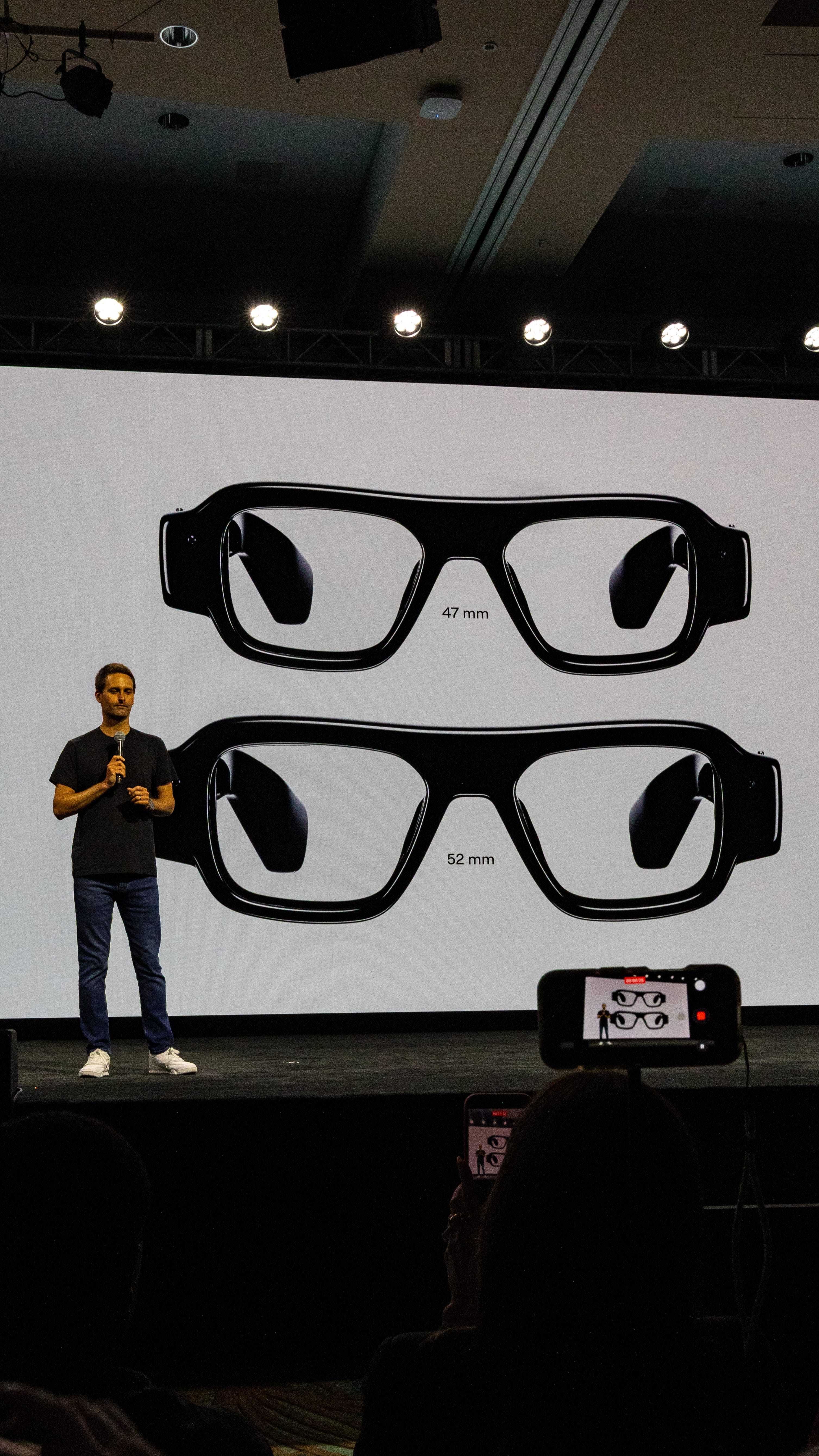
Snap clearly obsessed over the part where you actually have to wear these. They’re made from Swiss TR90 polymer and come in two sizes – the 47mm pair weighs 132g, the 52mm pair 136g. Removable inserts handle prescriptions, so glasses-wearers aren’t left out.
Battery life is the asterisk. You get up to four hours of mixed use – audio, video, AI, notifications, the works.
Battery life is the asterisk. You get up to four hours of mixed use – audio, video, AI, notifications, the works. The included charging case tops you off 4x more times for around 20 total hours. Four hours isn’t all-day, but it’s a solid hour-plus more than even the latest M5 Apple Vision Pro manages – and you’re not dragging a battery pack around on your hip to get it.
AI that can see what you see
The pitch Snap keeps coming back to is that AI gets dramatically more useful once it can see what you see. Instead of typing a question into a chat box, you look at something and ask about it, and the help shows up right where you need it. As CEO Evan Spiegel framed it, this is intelligence that understands what you’re trying to do in the moment, rather than intelligence stuck in a text window.
This is intelligence that understands what you’re trying to do in the moment, rather than intelligence stuck in a text window.
Snap is also opening the floodgates for developers. It’s rolling out a developer preview of what it calls agentic development – essentially building Lenses with AI coding assistants you may already use, including Claude Code, Codex, and Cursor. There’s also a new SPECS Spatial Benchmark, which measures how well AI models handle real-world spatial tasks like reasoning about layouts and how digital content should sit in a physical room, plus tools to help studios port existing projects over. More developers building means more reasons to actually wear the things at launch.
Privacy, because of course
Strapping cameras to your face invites the obvious questions, and Snap is getting ahead of them. Specs ask before tapping into sensitive info, lean on on-device processing, and light up an LED whenever they’re recording so the people around you know.
Back in 2016, I argued the original Spectacles’ obvious recording light was the right call – “we’re Snapchatters, not spies.” A decade later, that principle matters a lot more. Whether it’s enough to win over the room is a very 2026 problem we’ll all be living through together.
The price tag – and my early read


Now, the splash of cold water: Specs are not cheap. Pre-orders open today at Specs.com for $2,195, locked in with a $200 refundable deposit. They’re slated to ship this fall in the US, UK, and France. Earlier rumors floated $2,500 – so $2,195 is, weirdly, a small relief.
If Snap pulls this off, it just beat Apple, Meta, and Samsung to a product they’re all still working up to.
Will these outsell the impossibly trendy Meta Ray-Bans? Probably not. Those are a fashion accessory first and a gadget second. But that’s kind of the point. Specs aren’t trying to be jewelry – they’re trying to be the first AR glasses that put real spatial computing on your face without making you look like Carl from Up – which is more than I can say for Meta’s display glasses.
If Snap pulls this off, it just beat Apple, Meta, and Samsung to a product they’re all still working up to – and shipped quite possibly the most futuristic thing you’ll be able to buy this year. We’ll have a lot more to say once we get a pair on our face.
For now? A decade ago, a pair of Spectacles nearly got me thrown out of Yankee Stadium. If Snap’s right about where this goes, the next pair might just walk me back to my seat.
Up next: Xreal launches a more affordable range of AR glasses with HDR10 support