


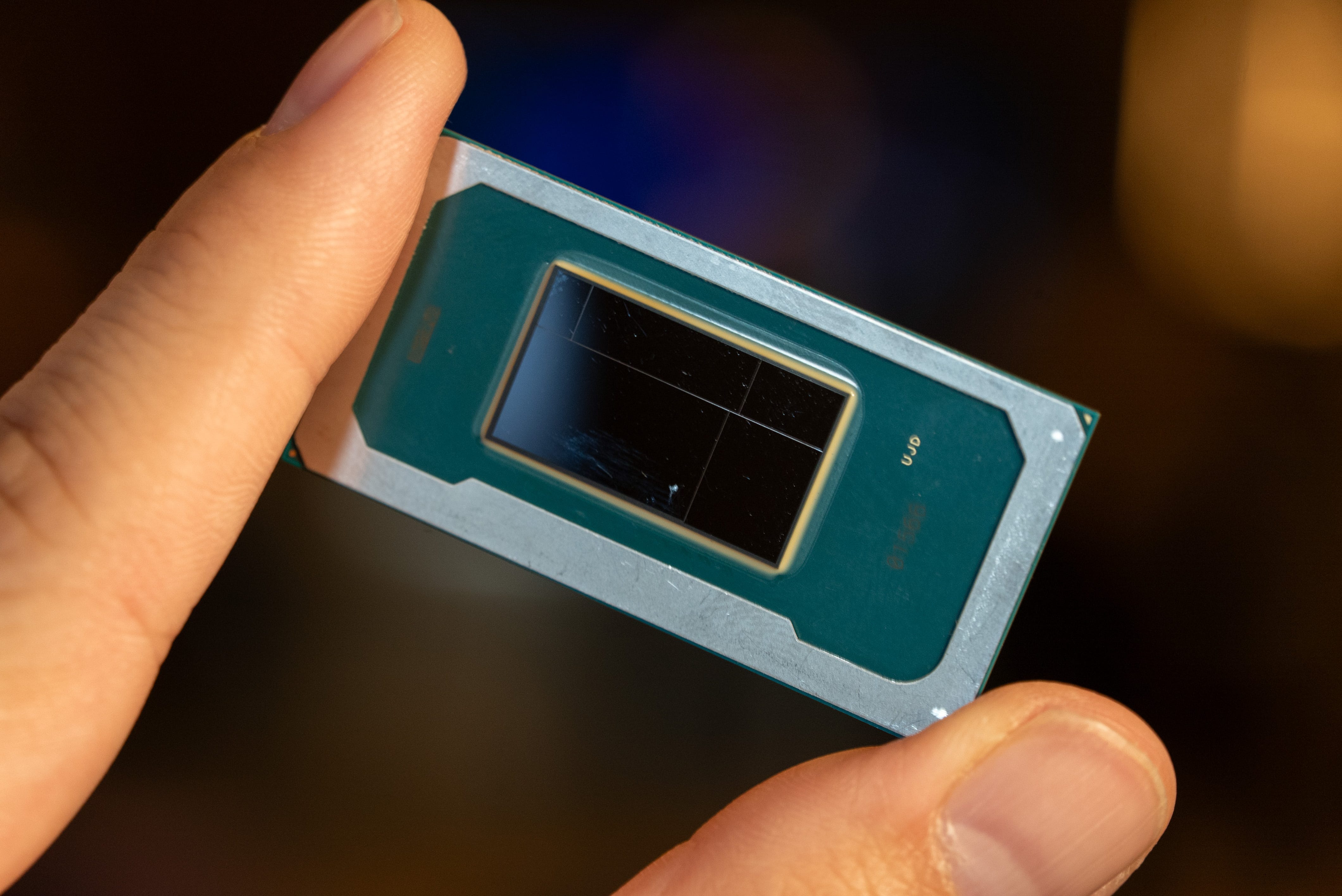

📣 Intel announces its new Panther Lake architecture built on a fundamentally new Intel 18A process
🎮 Features more powerful Xe2 graphics with Multi-Frame Generation for 100+ fps gaming
⚙️ New CPU architecture reintroduces E-cores for more and efficient multi-threaded performance
🤖 NPU TOPs remains at 50, but system TOPs have increased to 180
📈 RibbonFET replaces Intel’s long used FinFET since 2011 to potentially increase transistor counts from 20 billion to trillions
Love it or hate it, Multi-Frame Generation has made 100+ fps gaming possible on more devices. Now, Intel is introducing its own version alongside its new Panther Lake processors destined for everyday laptops.
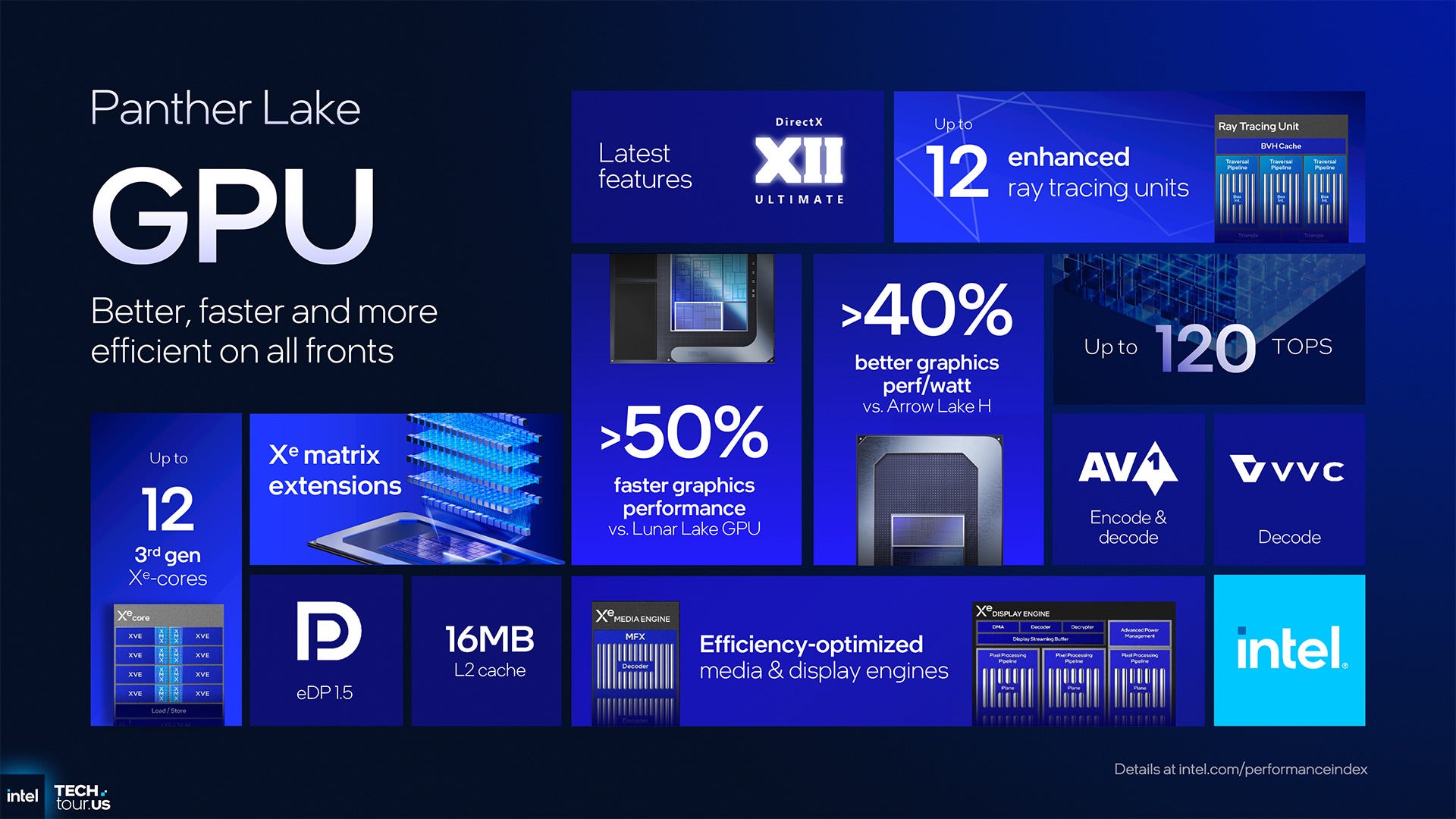
Panther Lake is the new successor Intel processor following Lunar Lake, which introduces a new heterogeneous architecture with a GPU tile that sits separate from the CPU tile. The new architecture also introduces Xe3 GPU cores, which, according to Intel, deliver 50% improved performance and half the latency of Lunar Lake’s Xe2 components.
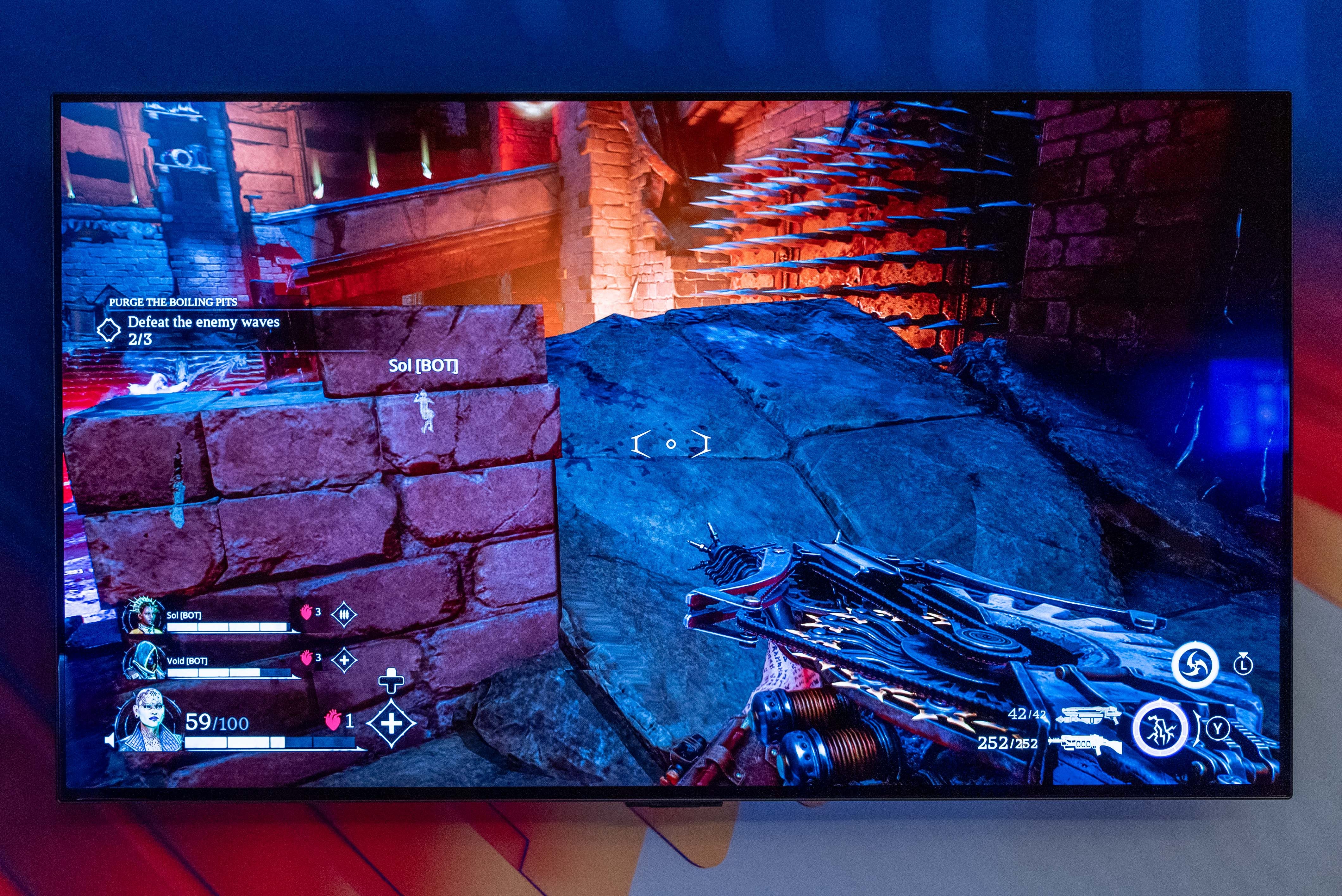
To further improve gaming on Panther Lake, Intel has also introduced new software, including XeSS-MFG. It essentially works just like Nvidia’s version of MFG created for its RTX 50-series GPUs in that it can create up to three generated frames between real frames rendered by the GPU. I played a demo of XeSS-MFG that allowed Painkiller to run at 128-140fps while the game was running at a native 28-35fps on a 45W 12Xe-powered device.
Intel is also introducing a cloud-based shader cache feature called Precompiled Shader Distribution for Panther Lake and its ARC graphics cards. This system essentially allows GPUs to stream automatic shader cache updates from Intel’s servers to reduce launch times and reduce stuttering. If you’ve played Borderlands on PC and hated waiting for shaders to rebuild or causing your performance to stutter, this feature could be huge.
Lastly, Intel said it will develop an improved Intelligent Bias Control v2, which helped the MSI Claw 8 AI+ unlock 10% higher fps with just a software update. The next Intelligent Bias Control v3 aims to further improve GPU priority while gaming by scheduling the E-cores first with a velocity-based algorithm.
What else is new about Intel Panther Lake?
There’s more to Panther Lake than just a new GPU tile and Multi-Frame Generation. Panther Lake introduces a fundamentally new Intel 18A process with new RibbonFET gates for more efficient and faster power delivery. To be clear, this is a monumental development as it replaces the FinFET process Intel has used since 2011, and it could allow the chip maker to scale from 20 billion transistors to trillions of transistors.
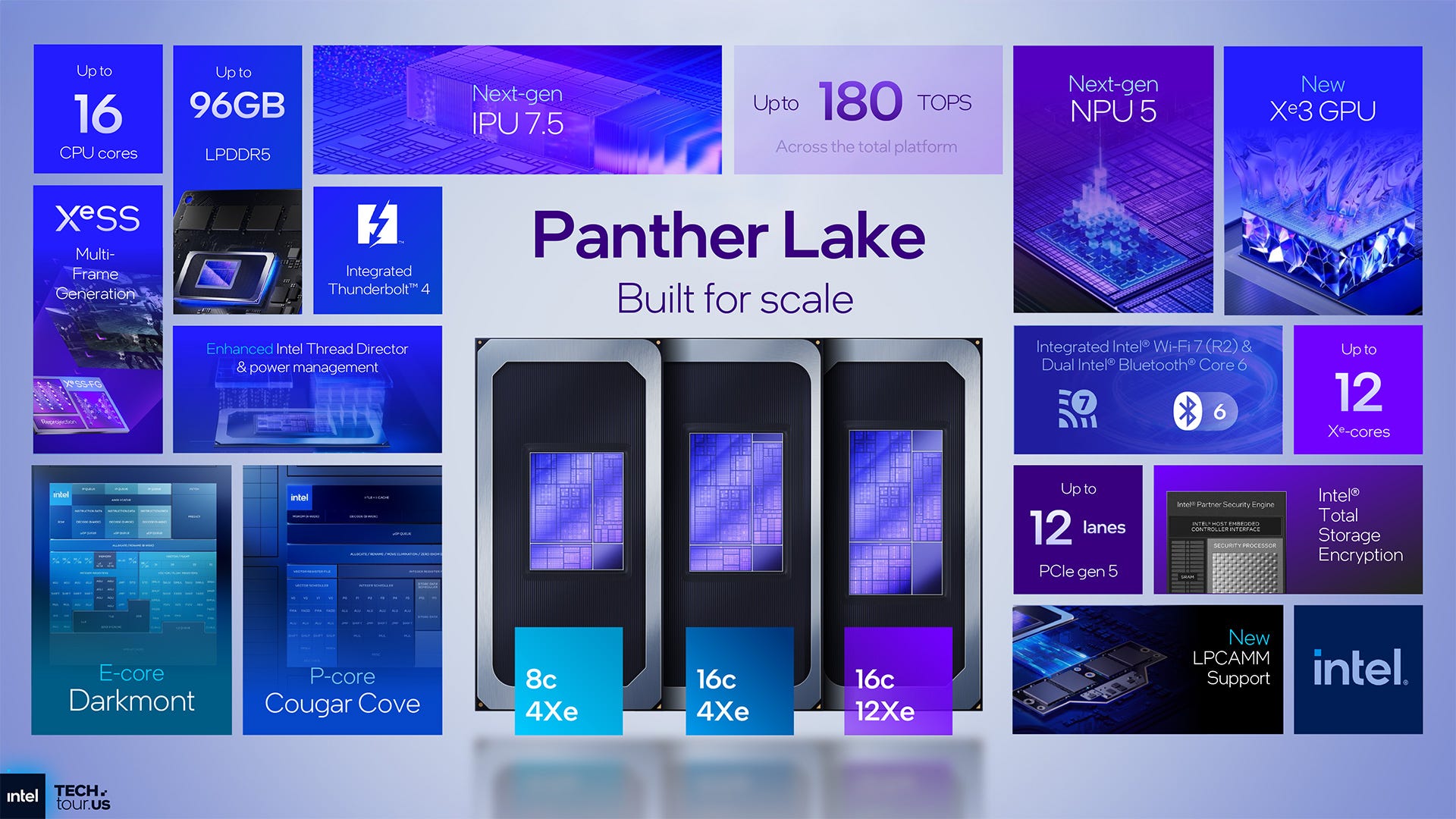
The CPU side of Panther Lake specifically reintroduces E-cores, which were missing entirely on Lunar Lake, to enhance multi-threaded performance by up to 50%. The NPU still delivers 50 TOPs just like Lunar Lake, but Panther Lake claims to improve performance by 40% and adds floating-point eight (FP8) support. Also, in total, the system TOPs have increased to 180 over Lunar Lake’s 120 system TOPs.


Panther Lake also ditches onboard memory, but expands external memory support for up to 96GB of LPDDR5 9600mt/s or 128GB of DDR5 7200mt/s RAM. Other platform improvements include Wi-Fi 7 R2 and Bluetooth 6, the latter of which can utilize a dual Bluetooth radio to double its range up to 60 meters.


So far, Intel has released plans to introduce three SKUs of Panther Lake, including two 8-core and 16-core modules with 4 Xe3 GPU cores, and a higher-end 16-core chip with 12 Xe3 GPU cores – that last one will be most ideal for gaming.
Intel is already producing Panther Lake chips in mass at its new Ocotillo Fab 52 in Chandler, Arizona, and we should see new devices this January at CES 2026.
Kevin Lee is The Shortcut’s Creative Director. Follow him on Twitter @baggingspam.